
for organisations
more capacity, less burnout
Nervous system training for leaders and teams in high-pressure organisations.
Grounded in behavioural science, somatic practice and breathwork. Delivered live, with the soma reset app carrying the practice between sessions.
- under loadthe 90-minute workshop
- capacitythe program, coming soon
- sydneyin person and online
what the work is built to change
less burnout
Recovery scheduled into the working week. Load made visible before it compounds.
better decisions
Clearer thinking under pressure. More deliberate responses when the stakes are high.
more capacity
Greater range under pressure. Faster return to baseline afterwards.
when this applies
- sustained workload or KPI pressure
- restructures, change programs or leadership transitions
- rising burnout, leave or attrition risk
- psychosocial risk management (supports, never replaces, your WHS obligations)7
the science
you cannot train System 2 into a body that’s in threat
Behavioural science distinguishes fast, automatic thinking (System 1) from slow, deliberate thinking (System 2).1 Leadership training develops System 2.
Deliberate thinking is physically effortful.2 Under threat, the body prioritises speed: attention narrows,3 options drop out of view, and people default to fast, automatic responses.
attention narrows
- just get it done
- no time for this
- do what we did last time
the options come back
- what’s actually being asked?
- what else could work here?
- who needs to be in this?
This work trains the state underneath. Recognising the shift earlier, and returning to deliberate thinking faster.
what it costs
the same person, given the same facts on a different day, can make a different call
Kahneman, Sibony and Sunstein call this occasion noise.4 Mood and fatigue are among the causes they describe.
It’s easy to miss, because nobody sees the decision they would have made on another day. The state people bring to a decision is the part this work trains.
the gap
organisations invest in how people think, then deploy them into conditions where that thinking is unavailable
health
EAPs, apps, activity challenges. Valuable, and largely reactive.
the state thinking runs on
Sits between two budgets. This is where this work sits.
thinking
Frameworks, feedback models, difficult conversations. All assume a regulated state.
the method
pressure shows up in the body before it shows up in a decision, so that’s where the work starts
somatic practice
body
The jaw, the shoulders and the breath change before the thinking does. People learn to catch the shift there, while there is still a choice.
breathwork
breath
Heart rate rises a little on each in-breath and falls on each out-breath. A longer exhale is a lever anyone can use in the middle of a meeting, without anyone else noticing.5
behavioural science
behaviour
A shared language for what pressure does to thinking, so a team can spot it in the room and name it without making it personal.
three disciplines
between sessions
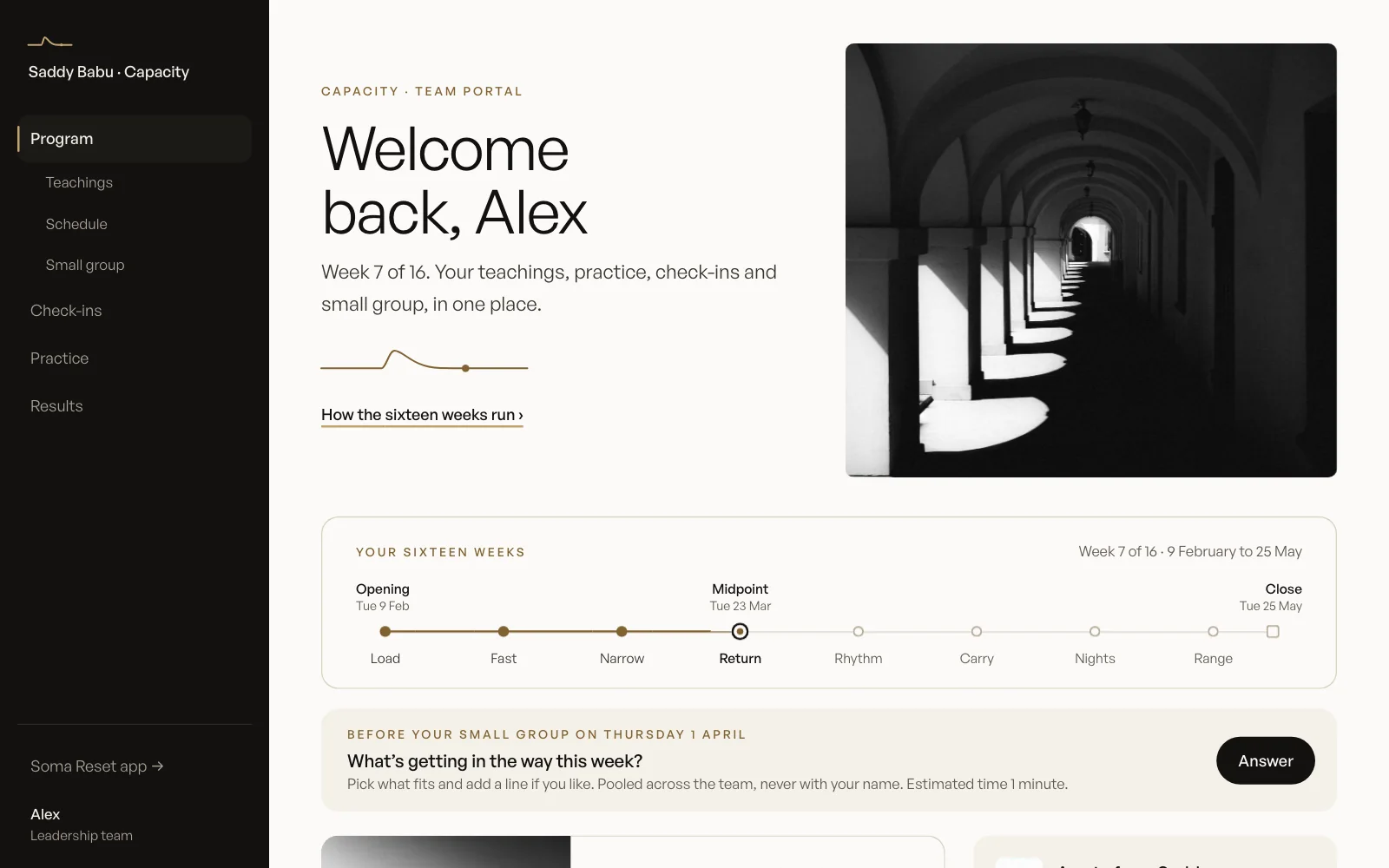
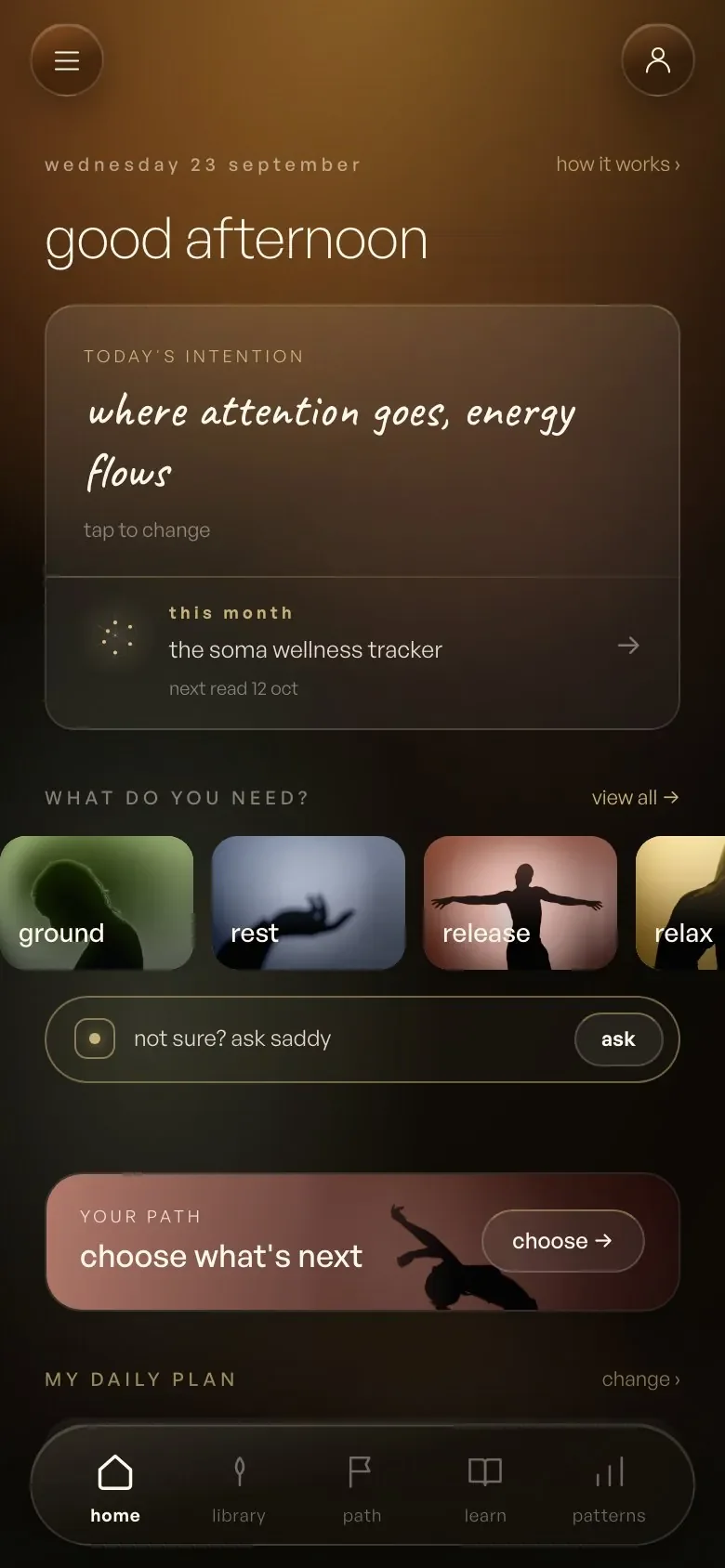
the soma reset app, with a portal for your team
Short practices sized for the gaps a real diary has, including audio for the drive home. Nothing to book.
Each team gets its own portal inside the app: this week’s practice, a two-minute check-in, the next small group, and a read only they can see.
recovery
same load, faster return
Pressure is part of the work. Load compounds when nothing brings people back to baseline between high-load moments, so each one starts where the last left off.
Each moment starts where the last one left off, and by Friday the week is running outside range.
The same five moments, with a return to baseline in between.
an illustration, not measured data
the workshop
under load
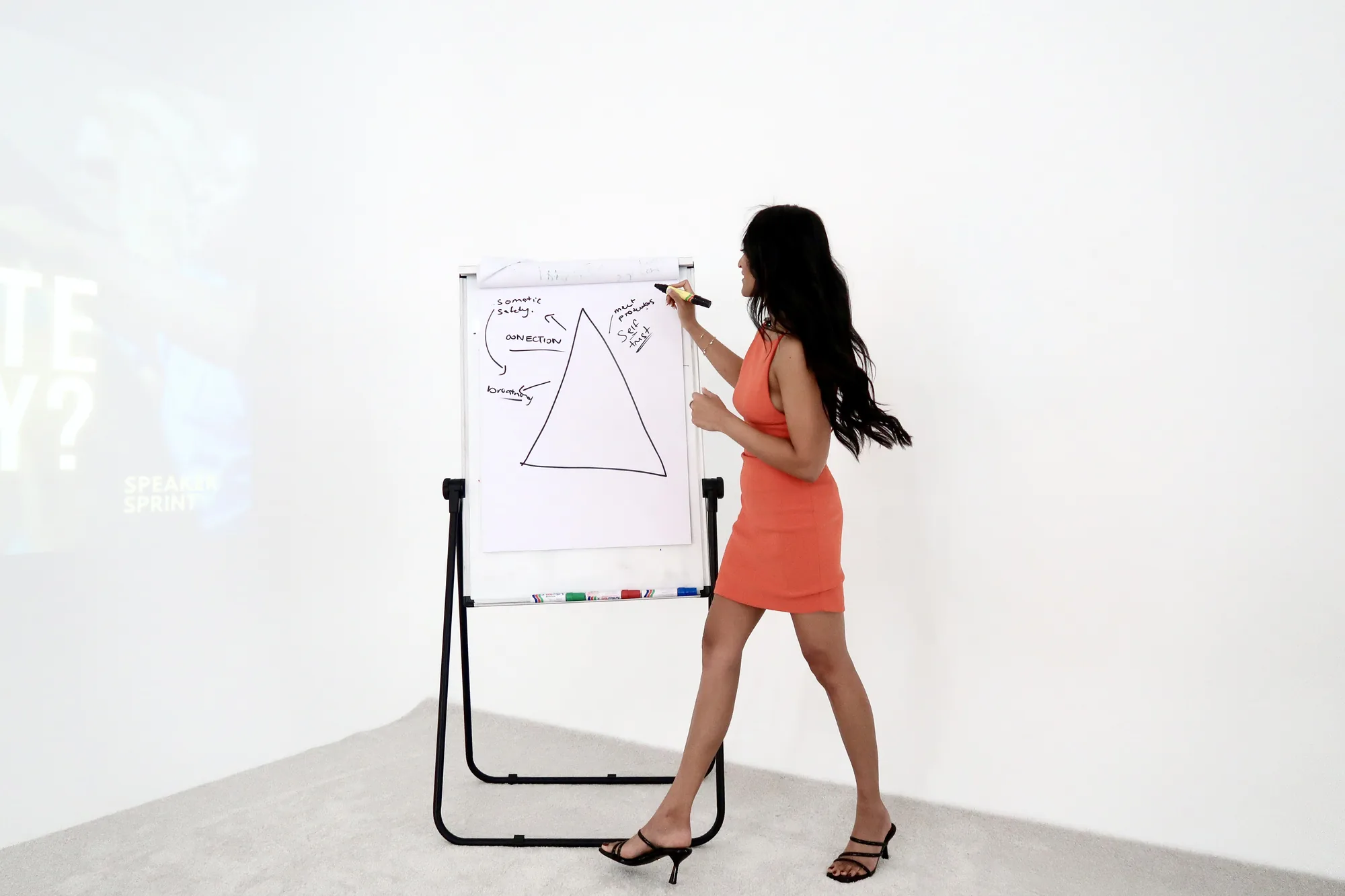
A 90-minute working session on performance under pressure.
Participants work through one real pressure moment from their own week, from impact to recovery. Two short in-chair practices. Three commitments to action.
- format90 min · in person
- group8–40 participants
- settingchairs, natural light, no floor work
- participationeyes open · opt out of any practice · no disclosure required
- privacyno individual data collected
Also available: 45 min · half day · online
01
one pressure moment
Each participant brings a real moment from their own week and works it through, from impact to recovery.
02
two practices
Short, in the chair and eyes open. No floor work, and no disclosure required.
03
three commitments
Three commitments to action, made before people leave the room.
inside the 90 minutes
the program
capacitycoming soon
A multi-month program for leadership teams.
Three live sessions, two small-group sessions online, daily practice through the soma reset app, and a team-level read at the start, midpoint and close, on a live page and in a short report. Minimum cohort of 8.
privacy
the organisation never sees a person
Every question counts days in the last week, rather than asking people to rate themselves. Counting last week measures last week.
the organisation sees
- aggregate trends by domain, e.g. sleep
- change across the program
- where load concentrates, by team
the organisation never sees
- individual results
- anything a participant writes, chooses or practices
- any group below the minimum size
Written into every agreement. Aggregate reporting only.
where load concentrates, by team
what a sponsor can act on
- load is concentrated in one team
- sleep across the cohort is sitting low
scope
what this is not
not clinical care
Education and prevention. Participants who need more support are referred on.
not a willpower model
Willpower as a limited resource (“ego depletion”) failed to replicate.6 It is not part of this work.
not brain regions
System 1 and System 2 are descriptive models, not brain structures. Kahneman described them the same way.
questions
Do people have to share anything personal?
No. No disclosure is required, practices are done eyes open, and anyone can sit a practice out without explaining why.
How do you measure change?
With a short counted check-in at the start, midpoint and close, and a two-minute one each fortnight between, beside a published burnout measure, so you see movement in terms you already know. Results show only for the whole group, never below eight people, and your team’s answers are stored in Australia.
What if something comes up for someone?
The practices are short and done in the chair. If something goes deeper than a work room should, I’ll point that person towards the right support.
What do you need from us?
A room with chairs and natural light, and between 8 and 40 people for 90 minutes. No floor work and no special equipment.
Can it run online, or in a shorter slot?
Yes. Under load also runs as 45 minutes, a half day or online.
How is it priced?
Every engagement is scoped to your team, the format and your timing. The written proposal sets out the investment.
Does it replace our EAP or our WHS obligations?
No. It sits alongside them, and it supports, never replaces, your WHS obligations for psychosocial risk.
what this draws on
- Kahneman, D. (2011). Thinking, Fast and Slow. Farrar, Straus and Giroux.
- Kahneman, D., & Beatty, J. (1966). Pupil diameter and load on memory. Science, 154(3756), 1583–1585.
- Easterbrook, J. A. (1959). The effect of emotion on cue utilization and the organization of behavior. Psychological Review, 66(3), 183–201.
- Kahneman, D., Sibony, O., & Sunstein, C. R. (2021). Noise: A Flaw in Human Judgment. Little, Brown Spark.
- Balban, M. Y., et al. (2023). Brief structured respiration practices enhance mood and reduce physiological arousal. Cell Reports Medicine, 4(1), 100895. A small, one-month study: promising, and not the last word.
- Hagger, M. S., et al. (2016). A multilab preregistered replication of the ego-depletion effect. Perspectives on Psychological Science, 11(4), 546–573.
- Safe Work Australia (2022). Model Code of Practice: Managing psychosocial hazards at work.

facilitator
Saddy Babu
Former media executive. Works with leaders and teams on performance and recovery under pressure, drawing on behavioural science, somatic practice and breathwork.
- certified somatic practitioner & nervous system educator
- certified breathwork facilitator
- specialising in parts work & emotional integration
the short version
range is what you can take. return is whether it costs you.
enquire
make an enquiry
For teams of 8 or more. Share your context and you'll get an honest view on fit.
what happens next
- a reply from meto the work email you share
- a short callyour team, the pressure it’s under and your timing
- a written proposalthe format, the options and the investment